



Rare & Unusual Tubers: Oca, Cinnamon Vine and Comfrey
This page is our collection of unusual tubers we’ve tried out over the years that turned out to be nice to eat and relatively easy to grow. We have tried out others as well, like Mashua, but didnt like them. We only kept the nice ones and grow a few every year for you to have a go at.
Oca
 Dylan Keatings
This interesting oca was sent to us in 2007 by Dylan Keating, who we think got them originally from his brother in Peru. We received two and a half (!) tiny seed tubers from Cornwall, but they grew, and we have slowly been building up our stocks ever since.
This variety yields well for us, and makes consistently large and even shaped tubers in a pretty creamy yellow with red markings around the eyes.
They're a slightly different shape to our other varieties, smooth and more egg shaped.
 5 tubers, organic. £8.00
 Mixed Oca
We are now offering most of our oca in mixed packs. These are a good choice if you've not grown oca before, as you'll be able to see which do best in your garden, and keep tubers for sowing in future years from the most successful plants. We'd recommend keeping several types ongoing, as we definitely find variations in productivity from year to year depending on weather conditions and other factors.
Tubers will be the smaller grade but will grow just fine, final yield is not affected by the size of the original tuber.
At least 5 tubers from a minimum of 3 varieties, organic. £9.00 New Zealand Red
This red oca has a small amount of black pigment outlining each 'eye' on the tuber, which is quite subtle but has a striking effect. It was sent to us by Cath Hillman in Surrey, who is originally from New Zealand and is always one of our most productive varieties.
There's an interesting story in this - in the 1970s and 1980s the NZ goverment decided to research unusual plants that would grow there and could be high-value export crops. They did find and breed several things with varying success- you will probably know the Kiwi Fruit which was good, but also the (rather less tasty!) Kiwano Horned Melon.
However, few people outside NZ know they also had a government-funded oca research programme. Like us, they tried to breed new varieties from seed (oca seed is very rare). It was quite sucessful, and although not exported (we don't know why) oca are commonly sold in supermarkets in NZ, though they are just called 'Yams' by the New Zealanders.
Back to our story, Cath liked them very much, so when she found herself living in the UK she missed having them to eat. She eventually got hold of some from a NZ supermarket and grew them in Surrey, where they did just fine. And she later sent us some of hers to swap for our others; they did well for us and we have been bulking them up ever since.
6 tubers, organic. £8.00 Orange Oca with Red Eyes
A strain that makes beautiful orange tubers with swirly scarlet outlines over the eyes.
This is one of the first varieties that we grew, given to us by a west Wales friend who is a big oca fan, and it is still one of our most productive every season.
Interestingly, with this variety, the shade of orange varies each year, we think that different weather makes them come out lighter or darker.
packet of 5 seed tubers, organic. £8.00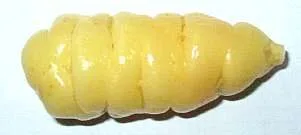 Pure White (From Frank) Oca
 £8.50
£8.50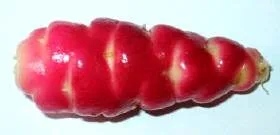 Scarlet Oca with White Eyes
A bright red strain that we have grown for many years. It makes beautiful tubers with pure white outlines over the eyes. We've done a lot of selection on this one and we're really pleased with the results. It gives good even sized tubers, nicely close into the plant for harvest and again is a productive variety.
packet of 5 seed tubers, organic. £8.00Cinnamon Vine
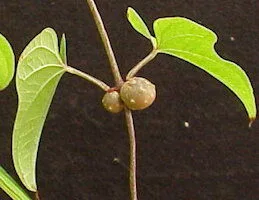 Andy’s Cinnamon Vine
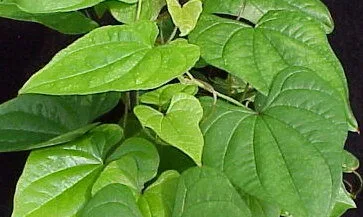
This is a nice unusual edible , but grown more for amusement rather than as a staple part of your diet. Our favourite thing about it is the incredible cinnamon scent that fills the air when it is flowering.
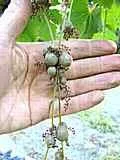
The plants make 2 types of tuber - a huge underground one that is impossible to dig up, and small 'air-tubers' attached to the stem at the base of each leaf. It requires very little maintenance - the top growth dies back in winter but then resprouts in spring.
They also have hundreds of small white flowers, which give off an intense cinnamon scent, fantastic in your polytunnel.
On receipt, either start the bulbils in a small pot, or plant them into a well manured weed free site, somewhere you can give them a support to climb. Be patient - bulbils may take some time to sprout in their first year.
Plants take 3-4 years to reach full maturity - the big edible root can then be up to 3 foot long, going straight down vertically. Digging it up is an interesting challenge! (Some people have suggested hiring a JCB digger and they might have a point). More helpfully, other gardeners grow them in deep tubs, stacks of old tyres or similar, and this is probably a more sensible approach if you aren't very, very fond of digging.
6 little bulbils, organic. £2.99